
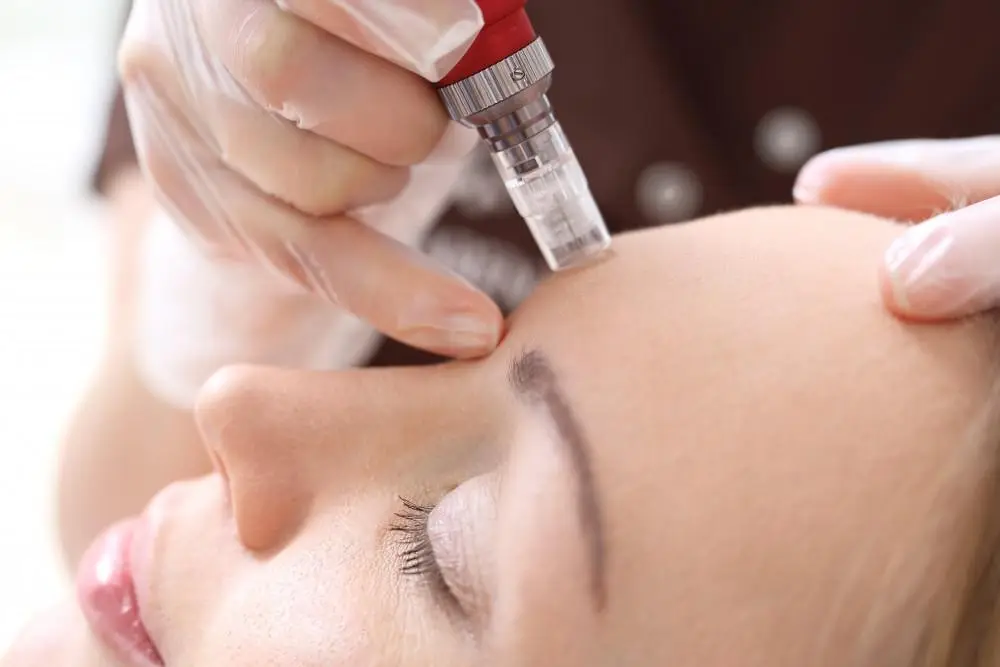
The short version: microneedling works by creating controlled micro-injuries that trigger your own collagen remodelling. One variable decides what it can actually achieve, and it is needle depth. A treatment reaching 0.5 mm improves surface texture and absorption. A treatment reaching 1.5 mm remodels collagen in the dermis. That difference is why professional treatment and at-home rollers are not the same procedure at different price points — consumer devices cannot reach the depth where the benefit is produced.
What follows is what each depth range reaches, how many sessions each concern realistically needs, and where standard microneedling ends and radiofrequency microneedling begins.
How the result is produced
Microneedling does not add anything to the skin. It provokes a response.
Fine needles create thousands of narrow channels through the epidermis and into the dermis. Each one is a small, controlled wound, and the body responds with the standard healing sequence: an inflammatory phase in the first days, a proliferative phase in which fibroblasts migrate in and lay down new matrix, and a remodelling phase in which that matrix is reorganised into stronger, better-aligned collagen. The remodelling phase continues for weeks after a single session, and for months across a course.
Two consequences follow from that, and both are commonly misunderstood:
- Results are delayed. The flush and plumpness in the first days is inflammation, not the result. The actual change appears from around four weeks and continues building for three months or more after a course finishes.
- The injury has to reach the right layer. Collagen remodelling happens in the dermis. An injury confined to the epidermis cannot produce it, regardless of how many times it is repeated.
What each depth reaches
This is the part that is almost never explained before treatment, and it is the single most useful thing to understand about microneedling.
| Depth | Layer reached | What it addresses |
|---|---|---|
| 0.25 – 0.5 mm | Epidermis only | Surface texture, dullness, improved absorption of applied products |
| 0.5 – 1.0 mm | Epidermis into papillary dermis | Mild fine lines, enlarged pores, early texture change |
| 1.0 – 1.5 mm | Papillary and upper reticular dermis | Fine lines, general texture, mild to moderate scarring — the main working range |
| 1.5 – 2.5 mm | Deeper reticular dermis | Established atrophic acne scarring, stretch marks, thicker skin areas |
Depth is not set once per face. Skin thickness varies substantially from the under-eye area to the cheek to the forehead, so depth is adjusted by region during a single treatment. A device run at one fixed setting across the whole face is either too shallow where it matters or too deep where the skin is thin.
What microneedling does well
Four applications have reasonable support and account for most of why we use it.
Fine lines and overall texture. Thinning dermal collagen allows creasing. Adding collagen back into the upper dermis thickens and smooths it. This responds well, and it is the most reliable use.
Atrophic acne scarring. Depressed scars are tethered or missing collagen. Needling breaks up the tethering and stimulates new matrix in the deficit. This works, but it requires depth, patience and usually six or more sessions. It improves scarring; it does not erase it, and anyone promising erasure is overselling.
Enlarged pores and rough surface. Partly a collagen-support issue around the follicle, which improves as the surrounding dermis thickens.
Product delivery. The channels temporarily allow better penetration of applied actives. This is genuine, and it is also why what gets applied during and after treatment must be chosen deliberately — a compromised barrier will absorb irritants just as readily. Nothing with fragrance or alcohol belongs on freshly needled skin.
Where it is weaker: significant skin laxity, deep volume loss and dynamic expression lines. Laxity generally needs added thermal energy or a lifting procedure, volume loss needs filler, and expression lines need a neuromodulator. Microneedling is often combined with those rather than compared against them.
Why at-home rollers are a different proposition entirely
This is worth being direct about, because the devices are inexpensive and widely sold, and the risk is not theoretical.
- They cannot reach the dermis reliably. Consumer needle lengths, and the pressure a person applies to their own face, do not deliver consistent dermal penetration. Without that, there is no collagen remodelling — only surface irritation.
- Rolling is mechanically different from stamping. A roller enters at an angle, drags laterally and exits at an angle, which tears the channel sideways. Professional devices stamp vertically, creating clean channels that close predictably.
- Reused needles are not sterile. Needles blunt quickly and home cleaning does not sterilise them. Blunt needles tear rather than puncture.
- Infection and pigmentation are the realistic risks. Introducing bacteria into dermal channels, or creating prolonged inflammation in richer skin tones, produces outcomes considerably worse than the texture being treated.
The asymmetry is the problem: the depth that makes a device safe to sell for home use is the same depth that makes it ineffective. A home roller is not a weaker version of professional microneedling — it occupies the range where there is irritation without remodelling.
Microneedling or RF microneedling
The practical decision most patients actually face.
| Consider standard microneedling | Consider RF microneedling |
|---|---|
| Surface texture, dullness, mild fine lines | Skin laxity and sagging alongside texture |
| Enlarged pores | Moderate to severe atrophic acne scarring |
| First professional treatment, gentler option preferred | Previous microneedling gave partial results |
| Lower cost per session | Fewer sessions often needed for the same change |
| Shorter recovery | Longer recovery, typically a few days of redness and swelling |
Radiofrequency microneedling adds heat delivered into the dermis through insulated needles, which drives a stronger tightening and remodelling response. The comparison is set out in more detail on the RF microneedling page. Where the aim is surface renewal and brightness with growth-factor support rather than structural remodelling, an EGF microneedling facial is the gentler route.
Recovery and the sessions that follow
Expect redness resembling moderate sunburn for one to three days, with some tightness and flaking as the surface renews. Mineral sunscreen and bland moisturiser only for the first several days; no retinoids, acids or vitamin C until the barrier has recovered; no makeup for the first 24 hours.
Sun protection afterward is not optional. Freshly treated skin is more prone to post-inflammatory pigmentation, and in Los Angeles ambient UV stays meaningful year round. Patients who skip it are the ones who come back disappointed.
Spacing of four to six weeks between sessions exists because remodelling from the previous session is still underway. Treating sooner interrupts the process rather than accelerating it.
Common questions
What does microneedling actually do to the skin?
It creates controlled micro-injuries through the epidermis into the dermis. That injury triggers the normal wound-healing sequence, and the remodelling phase of that sequence lays down new collagen and elastin over the following weeks to months. The result is produced by your own healing response rather than by anything applied during the treatment, which is why results appear gradually rather than immediately.
Does needle depth matter in microneedling?
Depth is the main variable that determines what a treatment can achieve. Roughly 0.25 to 0.5 mm reaches only the epidermis and affects surface texture and product absorption. Around 1.0 to 1.5 mm reaches the upper dermis where collagen remodelling happens, which is the range for fine lines and general texture. Depths beyond about 1.5 mm are used for established scarring and stretch marks. Depth is matched to the concern and to the area, since skin thickness varies considerably across the face.
Can at-home derma rollers achieve the same results?
No, and the reason is structural rather than a matter of quality. Consumer devices are limited to needle lengths that do not reliably reach the dermis, so they cannot trigger meaningful collagen remodelling. They also roll rather than stamp, which drags needles sideways and creates ragged channels instead of clean ones. Add reused non-sterile needles and the realistic outcomes are irritation, infection, pigmentation and in some cases scarring, without the benefit.
How many microneedling sessions will I need?
Most concerns need a course rather than a single appointment, typically three to six sessions spaced four to six weeks apart. The spacing is not arbitrary — collagen remodelling after each session continues for weeks, and treating again too early interrupts it. General texture and fine lines sit at the lower end of that range; acne scarring usually needs the upper end or more.
What is the difference between microneedling and RF microneedling?
Standard microneedling creates the micro-injury mechanically. Radiofrequency microneedling delivers heat energy through insulated needles into the dermis at the same time. The added thermal energy produces a stronger tightening and remodelling response, which makes it the better option for laxity and deeper scarring. Standard microneedling remains appropriate for surface texture, mild fine lines and product delivery, and it is the gentler of the two.
Is microneedling safe for darker skin tones?
Mechanical microneedling is generally considered a reasonable option across skin tones because it does not rely on light absorbed by pigment, which is the mechanism behind pigmentation risk with some lasers. That said, any inflammatory treatment carries some risk of post-inflammatory hyperpigmentation in richer skin tones. Conservative depth, careful technique and strict sun protection afterward all matter, and assessment should be done by someone who treats your skin tone routinely.
Reviewed by Daniel Moghadam, M.D., founder and medical director of Modern Aesthetica. Last reviewed October 2026. Microneedling is not appropriate during active acne infection, for certain scarring tendencies, or alongside some medications. Suitability is assessed in person.
Modern Aesthetica
8907 Wilshire Blvd, Suite 270, Beverly Hills, CA 90211
Phone: (213) 895-4730
Hours: Mon–Thu 10:00am–5:00pm · Fri 9:00am–5:00pm · Sat & Sun closed
Serving Beverly Hills, West Hollywood, Santa Monica, Brentwood, Hollywood and greater Los Angeles.


