
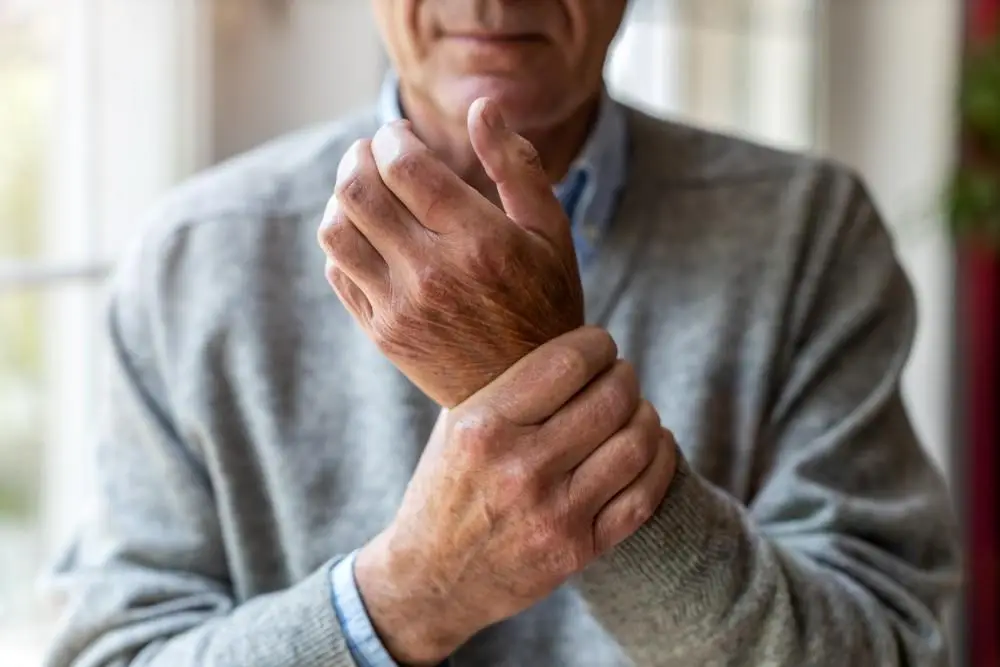
The short version: cartilage change with age is close to universal, but arthritis as an experience — pain and lost function — is not. The two get conflated because an X-ray is easy to show and symptoms are not. Imaging and symptoms match poorly in both directions: plenty of people with marked joint changes have no pain, and plenty with real pain have unremarkable images. That gap is where the modifiable risk sits, and most of it is weight, prior injury and muscle strength rather than age itself.
Below is what the imaging-symptom mismatch means for you, which risk factors are worth your effort, the exercise question most people get backwards, and an honest account of what injections can do.
Two different things called arthritis
When a clinician says you have arthritis, they may mean either of two things, and the difference determines your outlook.
| Radiographic osteoarthritis | Symptomatic osteoarthritis | |
|---|---|---|
| What it is | Structural change visible on imaging | Pain, stiffness and functional limitation |
| How it is identified | X-ray, MRI | Your history and examination |
| Prevalence with age | Very high; near universal in older age | Substantially lower |
| Modifiable | Largely not | Considerably, in many cases |
| Predicts the other | Only weakly | Only weakly |
The weak link between them is the important finding. Research comparing knee imaging with reported pain has repeatedly found that a large share of people with moderate to severe radiographic change report no significant pain, while a meaningful number with disabling pain show only mild change.
So being told there is arthritis on your scan is not a prognosis. It describes your joint’s structure at one moment. What determines whether you are in pain in ten years has more to do with your weight, the strength of the muscles supporting the joint, how well previous injuries were rehabilitated, and how active you remain.
What raises your risk, in rough order of how much it matters
- Excess body weight. Force through the knee during walking is several times body weight, so a pound lost removes roughly four pounds of peak load with every step. Weight also drives systemic inflammatory signalling, which matters because osteoarthritis is not purely mechanical. This affects the hands as well as the knees, which is the clue that inflammation plays a part.
- Previous significant joint injury. A ligament rupture or meniscal tear substantially raises the risk of osteoarthritis in that joint years later, regardless of weight or activity. This is the main reason osteoarthritis appears in people in their thirties and forties.
- Muscle weakness around the joint. Muscle absorbs load that would otherwise pass through cartilage. Quadriceps weakness is both a consequence of knee pain and a predictor of its progression, which creates a loop worth interrupting deliberately.
- Occupational loading. Repeated heavy lifting, prolonged kneeling and squatting carry measurable risk.
- Joint alignment and anatomy. Alignment concentrates load unevenly. Largely structural, though it changes how other factors act.
- Family history and sex. Real and not modifiable. Useful for knowing where to put your attention, not a verdict.
Notice what is not on that list: using your joints normally.
The exercise question, which most people have backwards
The intuition is that joints are like tyres and wear out with mileage, so protecting them means using them less. The evidence points the other way.
Cartilage has no blood supply. It is nourished by joint fluid moving through it, and that movement is driven by cyclical loading. A joint that is loaded regularly maintains its cartilage better than one that is not. Prolonged immobilisation causes cartilage to thin.
Studies of recreational runners generally show rates of knee osteoarthritis similar to or lower than in sedentary people. The genuine risks lie elsewhere: an unrehabilitated previous injury, elite-level or occupational extreme loading, a sudden large jump in training volume, and continuing to train through joint pain rather than addressing it.
For a joint that already hurts, exercise remains among the better-supported treatments. It is not comfortable advice to receive, and it needs to be the right exercise — strengthening the supporting muscles, progressed gradually, usually with guidance — but avoiding movement reliably makes things worse over time.
When joint pain needs proper assessment rather than a treatment
Not all joint pain is osteoarthritis, and some causes need prompt diagnosis rather than symptom management. Seek medical assessment rather than booking any injection if you have:
- A hot, swollen, acutely painful joint, particularly with fever — this needs urgent evaluation
- Pain in several joints symmetrically, with morning stiffness lasting more than an hour — a pattern suggesting inflammatory arthritis, which needs different treatment entirely and benefits from early diagnosis
- Significant unexplained weight loss or night pain
- A joint that locks, catches or gives way mechanically
- Rapidly worsening pain over weeks
Inflammatory arthritis such as rheumatoid arthritis is a different disease from osteoarthritis, treated with disease-modifying medication, and early treatment changes long-term outcomes. Managing it as wear and tear loses time that matters.
What injections can and cannot do
For osteoarthritis that has been properly diagnosed and has not responded adequately to load management, strengthening and weight reduction, injections are one option among several.
Platelet-rich plasma uses a concentrate prepared from your own blood, injected into the joint to alter its inflammatory environment. The evidence is not uniform across joints: it is most developed for knee osteoarthritis, where a number of trials report reduced pain and improved function over months in selected patients. For other joints the picture is more mixed, and the quality of the underlying studies varies considerably.
What PRP does not do is regrow cartilage. No injectable treatment has demonstrated structural cartilage repair in a human joint. The benefit, where it occurs, is symptomatic. We set out which indications we consider better supported and which we do not on the PRP therapy page, and our general position on reading this field critically on the regenerative medicine page.
One caution about a common alternative: corticosteroid injection reduces inflammation and often relieves pain in the short term, but a two-year randomised trial in knee osteoarthritis found greater cartilage volume loss in patients receiving repeated triamcinolone injections every three months than in those receiving placebo. That does not make a single steroid injection unreasonable; it argues against using them repeatedly as a long-term strategy.
Where pain is specific to one joint, the assessment differs by site — our knee, hip and shoulder pages describe what we look for in each.
What is actually within your control
Reducing excess weight, building strength in the muscles around the joint, rehabilitating injuries properly rather than returning early, staying active within what the joint tolerates, and getting an accurate diagnosis before committing to treatment. None of that is novel, and all of it has better support than most of what is marketed.
Common questions
Does everyone get arthritis if they live long enough?
Age-related change in cartilage is close to universal, but symptomatic osteoarthritis — joint pain and loss of function — is not. Many people reach advanced age with visible joint changes on imaging and no meaningful pain or limitation. The distinction matters because the changes on an image are largely not modifiable, while several of the factors that determine whether those changes cause pain are.
Can you have arthritis on an X-ray but no pain?
Yes, and it is common. Studies comparing imaging with symptoms consistently find substantial mismatch in both directions: a large proportion of people with moderate or severe radiographic changes report no pain, and a considerable number with significant pain have only mild changes on imaging. An X-ray describes joint structure. It does not measure how your joint feels or how well it works.
Does running cause knee arthritis?
The evidence does not support that for healthy joints. Studies of recreational runners generally find similar or lower rates of knee osteoarthritis than in sedentary people. Cartilage responds to cyclical loading by maintaining itself, and prolonged inactivity is associated with worse joint outcomes rather than better ones. The genuine risk factors are previous significant joint injury, elite-level or occupational extreme loading, and running through an injury rather than resting it.
What actually raises my risk of symptomatic arthritis?
The factors with the strongest evidence are excess body weight, a history of significant joint injury such as a ligament or meniscal tear, weakness in the muscles supporting the joint, occupations involving repetitive heavy loading or kneeling, joint malalignment, and family history. The first three are the ones most open to change, which is where effort is best directed.
How much does losing weight help joint pain?
Mechanically, more than the number suggests. During walking, force through the knee is several times body weight, so each pound lost reduces peak load through the joint by roughly four pounds with every step. Weight loss also reduces systemic inflammatory signalling, which is relevant because osteoarthritis involves inflammation as well as mechanical wear. It is among the interventions with the most consistent support.
Can PRP or any injection rebuild cartilage?
No injection has been shown to regrow cartilage in a human joint. Platelet-rich plasma is used to modulate the inflammatory environment within a joint, and in knee osteoarthritis there is reasonable evidence that it can reduce pain and improve function for a period in appropriately selected patients. That is a symptomatic benefit, not structural repair, and any provider describing an injection as regenerating or rebuilding your joint is overstating what the evidence shows.
Reviewed by Daniel Moghadam, M.D., founder and medical director of Modern Aesthetica. Last reviewed October 2026. Joint pain has many causes, some requiring prompt diagnosis. This article is educational and does not replace assessment by a clinician who has examined you.
Modern Aesthetica
8907 Wilshire Blvd, Suite 270, Beverly Hills, CA 90211
Phone: (213) 895-4730
Hours: Mon–Thu 10:00am–5:00pm · Fri 9:00am–5:00pm · Sat & Sun closed
Serving Beverly Hills, West Hollywood, Santa Monica, Brentwood, Hollywood and greater Los Angeles.


