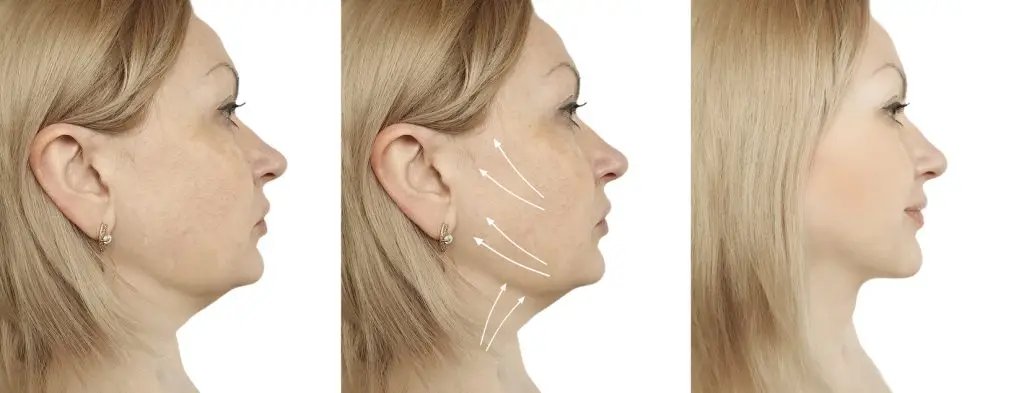
The short version: a non-surgical lower face lift can improve a blurred jawline, a receding chin, marionette lines and mild looseness under the chin, but it cannot reposition descended tissue the way a facelift does. The right tool depends on the problem: filler restores structure along the jaw and chin, neurotoxin relaxes platysma bands, and ultrasound can modestly tighten the neck. The effects are partial, most need maintenance, and radiofrequency microneedling and threads carry specific risks that deserve a direct conversation before treatment.
Can you lift the lower face without surgery?
You can improve it, modestly, but you cannot lift it the way a facelift does. The American Society of Plastic Surgeons describes the results of non-surgical alternatives as moderate and less dramatic, notes that the treatments need to be repeated every few months, and observes that the aging process continues regardless of what is done. A plastic surgeon writing on the Society’s site calls the facelift itself still the most effective option for more dramatic, longer-term improvement. The useful question is therefore which specific problem you have, because each non-surgical tool addresses a different one, and none of them addresses all.
The lower face is a composite of at least four separate problems: a jawline that has lost definition because bone and fat have receded, jowls that form where the skin and deeper tissue are held in place by fixed anchor points while the tissue between them descends, folds and creases at the corners of the mouth, and looseness of the skin under the chin and along the neck. Anatomical work by Rohrich and Pessa showed that facial fat sits in discrete compartments that age at different rates, and Pessa’s later work on fusion zones helps explain why jowls form in a predictable place. Matching treatment to mechanism is the whole strategy.
Which treatment fits which problem?
| Problem | Treatment most often used | What the regulators and the evidence say |
|---|---|---|
| A blurred or receding jawline and chin | Hyaluronic acid or calcium hydroxylapatite filler placed along the jaw and chin to restore structure. | The FDA approved Juvéderm Volux XC for improving jawline definition in adults over 21 in July 2022, with results lasting up to 12 months, and Radiesse carries a labeled indication for jawline contour. Restylane Defyne was approved for chin retrusion in 2021. |
| Marionette lines and downturned mouth corners | Filler in the marionette area, sometimes combined with neurotoxin in the muscles that pull the corners down. | Filler for this area generally relies on broader wrinkle indications or off-label use, and a 2025 study noted the lack of published clinical data specific to it. The neurotoxin component is off-label. |
| Looseness under the chin and along the neck | Focused ultrasound or radiofrequency devices that heat deeper tissue to stimulate contraction. | Ultherapy is FDA-cleared to lift lax tissue beneath the chin and neck, and to lift the eyebrow, but its clearance does not name the jowls or jawline. |
| Visible vertical bands in the neck | Botulinum toxin placed in the platysma muscle. | Botox Cosmetic was approved for platysma bands in October 2024, which makes this an on-label use. |
| Mild to moderate sagging of the cheek and jowl area | Absorbable threads that fixate tissue in a lifted position. | The cleared use of at least one thread device is mid-face suspension of the cheek, not the jowls, and long-term efficacy data are lacking. |
| Skin texture and early laxity | Radiofrequency microneedling, with or without collagen-stimulating injections such as Sculptra. | Radiofrequency microneedling devices are cleared for coagulation and contraction of soft tissue in dermatologic procedures rather than for lifting, and Sculptra is labeled for folds and wrinkles rather than for jawline contour. |
What does the evidence show for ultrasound lifting?
Micro-focused ultrasound is the most thoroughly studied energy-based option. The FDA clearance rested on an open-label trial in which 51 of 70 patients achieved at least 20 square millimeters of lift, and 84.3 percent of those were confirmed by masked reviewers. A 2025 pooled analysis of 42 studies in Aesthetic Surgery Journal found that 89 percent of patients improved according to investigators and 84 percent reported improvement themselves, although satisfaction fell to 62 percent when “neutral” was an allowed response, and the authors warned that the results may be overestimated. A separate analysis found that the response rate was 77 percent at 90 days and 69 percent at 180 days.
The magnitudes are small. A 2023 review reported eyebrow lift of roughly 0.5 to 1.7 millimeters and reductions in the submental area of 26 to 45 square millimeters, and it noted that long-term follow-up data are not available. A 2025 safety review of 19 articles found mostly transient swelling and redness, but a search of the FDA adverse event database for the device turned up reports of fat loss, nerve injury, focal numbness and, in one case, a facelift that was compromised, and the authors characterized the evidence on later facelifts as anecdotal.
What about the Nefertiti lift, threads and radiofrequency microneedling?
The Nefertiti lift, which places neurotoxin along the jaw border and into the platysmal bands, has been evaluated in one 30-patient study. Platysmal bands improved significantly, whereas the jowls, marionette lines and mouth corners showed only a tendency toward improvement that did not reach significance, even though 93.3 percent of patients rated the overall result as improved. The authors suggested it works best in younger patients with retained skin elasticity, and the use is off-label because the approved platysma indication is for the bands alone.
Absorbable threads have more complications than their popularity suggests. A systematic review of 26 studies reported swelling in 35 percent of patients, dimpling in 10 percent, altered sensation in 6 percent, a visible or palpable thread in 4 percent, and infection or extrusion in 2 percent each, with satisfaction falling from 98 percent immediately to 88 percent at long-term follow-up. A 2025 review of 12 studies and 818 patients found that scores improved immediately but that long-term efficacy data are lacking and that none compared threads with surgery.
Radiofrequency microneedling deserves a caution of its own. In October 2025 the FDA issued a safety communication stating that it was aware of serious complications from certain uses, including burns, scarring, fat loss, disfigurement and nerve damage, some requiring surgical repair, and advised patients to choose a licensed provider with training and experience while its evaluation continues. The devices are cleared for coagulation and contraction of soft tissue and not for lifting, so the “tightening” in marketing language rests on that wording.
What are the risks of filler along the jaw?
The most serious risk of any filler is injection into or compression of a blood vessel. The FDA states that complications can include tissue death, vision abnormalities including blindness, and stroke, and that an injector who sees signs of vascular injection must stop immediately. For hyaluronic acid products, a consensus recommendation calls for prompt treatment with high doses of hyaluronidase, at least 200 units, with the strongest outcomes when treatment begins within 24 hours. Choose an injector who can name the complication plan and has hyaluronidase in the room. Seek emergency care for sudden vision changes, severe or increasing pain, or skin that turns white, gray or mottled after an injection.
A realistic way to set expectations
Filler along the jaw and chin gives immediate structure, and a neurotoxin can relax downward pull, but neither tightens loose skin. Energy devices can tighten modestly. If your main complaint is heavy, descended tissue or a lax neck, expect a visible but partial improvement and a result that needs maintenance, and consider a surgical consultation alongside this one.
When is surgery the better answer?
Surgery wins when the problem is excess skin and descended deep tissue, because a facelift repositions the underlying structures and removes what has stretched, which no injection can do. If non-surgical treatments are producing diminishing returns, or if you would need several treatments a year to hold a change that one operation would deliver for much longer, a surgical opinion is a reasonable next step. Fillers, neurotoxin and biostimulators remain useful afterward, to replace lost volume and refine the result.
How we approach a lower face consultation
At Modern Aesthetica, Daniel Moghadam, MD, begins with an examination that separates volume loss, muscle pull and skin laxity, since each calls for a different tool, and explains what each option can and cannot achieve for your anatomy. Our services include dermal fillers, Botox, Sculptra and the PDO thread lift, and the consultation is the place to compare them honestly, including the risks above and when we would suggest seeing a surgeon instead.
Common questions
Can fillers lift jowls?
Filler can improve the appearance of jowls indirectly by restoring structure along the jawline and chin so that the transition between the face and the neck looks smoother, but it adds volume rather than lifting tissue, and heavy jowls caused by descended skin and deep tissue are generally better addressed surgically.
Is Ultherapy FDA-cleared for jowls?
No, because its clearance covers lifting the eyebrow, lifting lax tissue beneath the chin and neck, and improving lines and wrinkles on the chest, so use on the jowls and jawline is off-label and the supporting evidence is considerably weaker than it is for the cleared areas.
How long does jawline filler last?
The FDA label for Juvéderm Volux XC states that results may last up to 12 months, although the duration varies with the specific product, the area treated and the individual, and hyaluronic acid products can be dissolved with hyaluronidase if you are unhappy with the outcome.
Do thread lifts last?
The evidence is limited, because a 2025 review of 12 studies and 818 patients found early improvement but described long-term efficacy data as lacking, and a larger systematic review found that satisfaction declined from 98 percent immediately after treatment to 88 percent at longer follow-up.
Does Botox lift the jawline?
Botox Cosmetic is approved for visible vertical bands in the neck, whereas injections along the jaw border are an off-label technique, and in the one study of that approach the bands improved significantly while the jowls and mouth corners showed only a tendency toward improvement that did not reach significance.
Is radiofrequency microneedling safe for the face?
It can be, but in October 2025 the FDA issued a safety communication about serious complications from certain uses, including burns, scarring, fat loss and nerve damage, so you should choose a provider with specific training and ask about the device settings, the treatment depth and the plan for managing complications.
How old should I be to consider a non-surgical lower face lift?
There is no set age, because treatments are matched to the problem rather than to a birthday, so someone in their thirties with a blurring jawline may need only filler or neurotoxin, whereas looseness that develops later is more often addressed with energy devices or a surgical opinion.
Sources
- American Society of Plastic Surgeons, What is a nonsurgical facelift? (2018)
- American Society of Plastic Surgeons, Modern approaches to the traditional facelift (2018)
- US Food and Drug Administration 510(k) K180623, Ulthera System indications (2018)
- Amiri and colleagues, pooled outcomes of micro-focused ultrasound with visualization, Aesthet Surg J 2025;45(3):NP86
- Contini and colleagues, review of micro-focused ultrasound for skin lifting, Int J Environ Res Public Health 2023;20(2):1522
- Humphrey and colleagues, safety review of micro-focused ultrasound, Dermatol Surg 2025;51(4):424
- US Food and Drug Administration, Juvéderm Volux XC approval for jawline definition (2022)
- Galderma, FDA approval of Restylane Defyne for chin augmentation (2021)
- Merz Aesthetics, FDA approval of Radiesse for jawline contour
- US Food and Drug Administration, Sculptra approval for cheek wrinkles (2023)
- Botox Cosmetic prescribing information, including platysma bands (revised October 2024)
- Jabbour and colleagues, botulinum toxin for the Nefertiti lift, Plast Reconstr Surg 2017
- US Food and Drug Administration 510(k) K200140, absorbable suture for mid-face suspension (2019)
- Niu and colleagues, complications of thread lifting, Aesthetic Plast Surg 2021;45:2148
- Riopelle and colleagues, review of absorbable thread lifts, Dermatol Surg 2025;51(5):509
- US Food and Drug Administration 510(k) K231790, radiofrequency microneedling device indications (2023)
- US Food and Drug Administration, safety communication on radiofrequency microneedling (October 15, 2025)
- US Food and Drug Administration, Dermal Fillers (Soft Tissue Fillers)
- Cohen and colleagues, consensus on hyaluronidase for filler complications, Aesthet Surg J 2015
- Rohrich RJ and Pessa JE, the fat compartments of the face, Plast Reconstr Surg 2007;119(7):2219-2227
- Pessa JE, the SMAS fusion zones and facial aging, Aesthet Surg J 2016;36(5):515-526
Reviewed by Daniel Moghadam, M.D., founder and medical director of Modern Aesthetica. Last reviewed November 2026. This article is educational and is not a substitute for a consultation; what is appropriate for you depends on your history, your examination and your goals.
Modern Aesthetica
8907 Wilshire Blvd, Suite 270, Beverly Hills, CA 90211
Phone: (213) 895-4730
Hours: Mon–Thu 10:00am–5:00pm · Fri 9:00am–5:00pm · Sat & Sun closed
Serving Beverly Hills, West Hollywood, Santa Monica, Brentwood, Hollywood and greater Los Angeles.