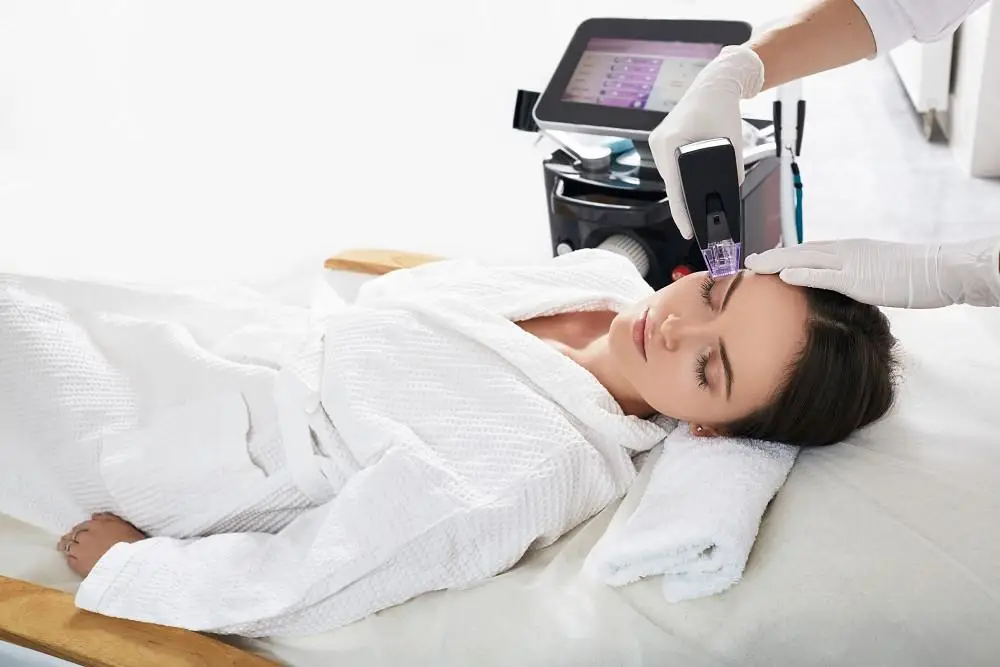
The short version: radiofrequency microneedling can produce modest, gradual improvement in skin texture, fine lines, mild laxity and acne scarring, with several weeks of visible recovery and results that continue to develop for months. It is not a substitute for a facelift, it does not remove deep folds, and the published evidence, while generally favorable, rests on small studies of uneven quality. The device, the depth settings and the skill of the operator matter more than the name of the technology.
How radiofrequency microneedling works
Conventional microneedling relies on mechanical injury: fine needles create thousands of narrow channels in the skin, and the repair response, which includes new collagen and elastin deposition, is what produces the improvement. Radiofrequency microneedling adds a second mechanism. The needles act as electrodes, so that once they reach the chosen depth they deliver radiofrequency energy into the dermis and generate controlled thermal injury at that level. Because the energy is released below the surface, the epidermis is spared far more than it would be by an ablative laser, which is the principal reason downtime is shorter.
The thermal component is intended to do what mechanical injury alone does less reliably, namely to heat dermal collagen enough to contract existing fibers and to trigger a more vigorous remodeling response. In a critical review of the literature, collagen and elastin changes were slow and progressive and continued to improve for as long as six months after treatment, which explains why a clinician who promises a result within a week is describing swelling, not remodeling.
Devices differ in several ways that affect both results and risk: whether the needles are insulated along their shafts (so that energy is released only at the tip), whether depth is adjustable within a single session, how much energy is delivered per pulse, and whether the energy is monopolar or bipolar. Those choices are the reason two clinics offering “RF microneedling” can deliver quite different treatments.
What the evidence shows, and where it is thin
A review of the radiofrequency microneedling literature through 2020 identified fourteen studies on skin rejuvenation and seven on acne scars, alongside smaller bodies of work on stretch marks, excessive sweating, melasma and other indications. Its conclusion was that the technique is effective, can be repeated safely, and can be combined with other modalities, including in people with darker skin. A separate systematic review of Fitzpatrick types III to VI found thirty-five relevant articles and a low overall risk of scarring or lasting pigmentary change, although seven studies noted transient post-inflammatory hyperpigmentation, one noted mild prolonged hyperpigmentation, and one reported permanent scarring. The second review cautioned that a large share of the included studies lacked strong quality evidence, and the same limitation applies to the field as a whole.
In practical terms, the evidence supports a clear ordering by indication:
| What you hope to improve | How well it is supported | What a realistic expectation looks like |
|---|---|---|
| Acne scars, particularly rolling and boxcar types | Strongest, with the largest number of studies and consistent improvement reported | Gradual softening across a series of sessions; deep ice-pick scars usually respond less than shallow ones |
| Skin texture, enlarged pores and fine lines | Reasonable, with most trials small and many without a control group | A smoother, firmer-feeling surface that develops over two to three months rather than days |
| Mild to moderate skin laxity on the lower face and neck | Moderate, and the measured effect is modest | A subtle improvement in tone and definition, not the repositioning of tissue that surgery produces |
| Deep folds, jowls and heavy neck bands | Weak; these reflect volume shifts and ligament laxity that energy alone does not correct | Little visible change; a surgical or volumizing approach is usually more appropriate |
Two cautions follow from that table. First, much of the marketing language, which promises a “non-surgical facelift,” describes the upper end of what individual reports show rather than the typical result. Second, many comparative statements about one brand of device being superior to another come from manufacturer-sponsored studies, which should be read with that in mind.
Who is a good candidate, and who is not
People who tend to be satisfied are those with early to moderate textural change, mild laxity, acne scarring or enlarged pores who understand that improvement is incremental and who are willing to complete a series. People who tend to be disappointed are those with significant skin excess, pronounced jowls or a heavy neck who hope to avoid surgery; for them, the honest recommendation is often a different procedure.
Treatment is generally deferred or avoided in the presence of an implanted electronic device such as a pacemaker or defibrillator, pregnancy, an active infection or cold sore in the treatment area, an open wound or active inflammatory acne, a tendency toward keloid scarring, metal implants in the area to be treated, and recent isotretinoin use, with the interval that clinicians require varying between practices. A history of herpes simplex around the mouth usually calls for antiviral prophylaxis beforehand. Anyone with a bleeding disorder, an autoimmune condition or a history of poor wound healing should say so at the consultation.
A correction to a common claim
Radiofrequency microneedling is often described as safe for all skin types. The more accurate statement is that insulated-needle devices, conservative settings and an experienced operator lower the risk of pigmentary change in darker skin, not that the risk disappears. Post-inflammatory hyperpigmentation is the most commonly reported persistent adverse effect of microneedling in general, and darker skin tones remain at higher risk of it.
What the procedure and recovery involve
After cleansing, a topical anesthetic is applied for thirty to forty-five minutes, since the energy delivery is more uncomfortable than ordinary microneedling. The practitioner passes the handpiece over the treatment area in sections, setting needle depth according to skin thickness, so that the forehead, cheeks and neck are treated differently. The active treatment time is typically a half hour or less.
Expected effects in the first days include redness similar to a sunburn, swelling that is often most visible on the first morning, and a rough or sandpaper texture as the pinpoint wounds close. Small crusts or grid-pattern marks can appear for several days. Many people return to work within two to four days, although the schedule depends on the settings used and on how they want to look at a social event. Strict sun avoidance and daily broad-spectrum sunscreen are not optional during recovery, because newly treated skin pigments easily. Published protocols commonly use a series of three sessions spaced four to six weeks apart, with a maintenance session once or twice a year, but the number and spacing are decisions for the treating physician after examination, not fixed rules.
Risks worth knowing before you book
Most adverse effects are minor and transient, including redness, swelling, tenderness, dryness and peeling. Less common events include burns, which are most often traced to excessive energy or a mismatch between depth and skin thickness, blistering, infection, reactivation of cold sores, post-inflammatory hyperpigmentation and, rarely, scarring or an unexpected change in fat in the treated area. Seek prompt care for spreading redness, increasing pain after the first two days, pus, blistering or a rapidly developing dark patch.
Regulatory status deserves a direct question. Radiofrequency microneedling systems reach the US market through FDA 510(k) clearance, and clearance is specific to each device and to the indications written into it; some devices carry clearances tied to particular uses, and others are cleared for general electrosurgical use only. A clinic offering the treatment for wrinkles, laxity or scars should be able to tell you which device it uses and what that device’s clearance covers, and a patient is right to ask.
How it compares with the alternatives
Standard microneedling is gentler, less expensive and better suited to mild textural concerns; our overview of what microneedling does and how needle depth decides the result covers it in detail. Fractional laser resurfacing generally produces a stronger effect on scars and photodamage with a longer recovery. Ultrasound-based devices target deeper tissue for lifting with less surface injury, and a surgical facelift remains the only option that repositions tissue durably. Radiofrequency microneedling sits between standard microneedling and laser in both intensity and downtime, which is why it is a reasonable first step for someone who wants more than microneedling can give but is not ready for surgery.
The biology underneath all of these treatments is the same: collagen is renewable to a degree, while elastin largely is not, a distinction explained in our piece on collagen and elastin and what each can and cannot recover. Dr. Daniel Moghadam offers RF microneedling at Modern Aesthetica in Beverly Hills, and a consultation is the appropriate place to learn whether your concern is the kind this technology addresses.
Common questions
How many radiofrequency microneedling sessions do most people need?
Published protocols often use three sessions about four to six weeks apart, followed by occasional maintenance. The right number depends on the concern, with acne scarring generally needing more sessions than general texture improvement.
How long do the results of radiofrequency microneedling last?
Collagen remodeling continues for several months after the last session, but aging continues too. Most clinicians recommend maintenance once or twice a year, and the duration of benefit depends on your skin, sun exposure and the settings used.
Is radiofrequency microneedling painful?
Discomfort is usually well controlled with topical anesthetic, although the energy is felt as heat and pressure, particularly over bony areas such as the jawline and forehead.
What is the difference between RF microneedling and regular microneedling?
Regular microneedling causes mechanical injury only. Radiofrequency microneedling also delivers heat energy at the needle tip, which adds thermal remodeling and tightening and typically means more downtime.
Is radiofrequency microneedling safe for dark skin?
Evidence from reviews of Fitzpatrick types III to VI suggests a low risk of lasting pigment change or scarring when insulated needles and conservative settings are used, but temporary post-inflammatory hyperpigmentation does occur, so the operator’s experience matters.
Who should not have radiofrequency microneedling?
Typically people with a pacemaker or other implanted electronic device, pregnancy, an active infection or open wound in the treatment area, a tendency toward keloids, or recent isotretinoin use. Your physician will review your history and decide.
Can radiofrequency microneedling replace a facelift?
No. It can improve texture and produce a modest tightening effect in mild laxity, but it does not reposition tissue or correct deep folds and heavy jowls.
Sources
- Radiofrequency microneedling: a comprehensive and critical review. Dermatologic Surgery, 2021
- Radiofrequency and radiofrequency microneedling in skin of color: a review of usage, safety, and efficacy. 2023
Reviewed by Daniel Moghadam, M.D., founder and medical director of Modern Aesthetica. Last reviewed November 2026. This article is educational and is not a substitute for a consultation; what is appropriate for you depends on your history, your examination and your goals.
Modern Aesthetica
8907 Wilshire Blvd, Suite 270, Beverly Hills, CA 90211
Phone: (213) 895-4730
Hours: Mon–Thu 10:00am–5:00pm · Fri 9:00am–5:00pm · Sat & Sun closed
Serving Beverly Hills, West Hollywood, Santa Monica, Brentwood, Hollywood and greater Los Angeles.