
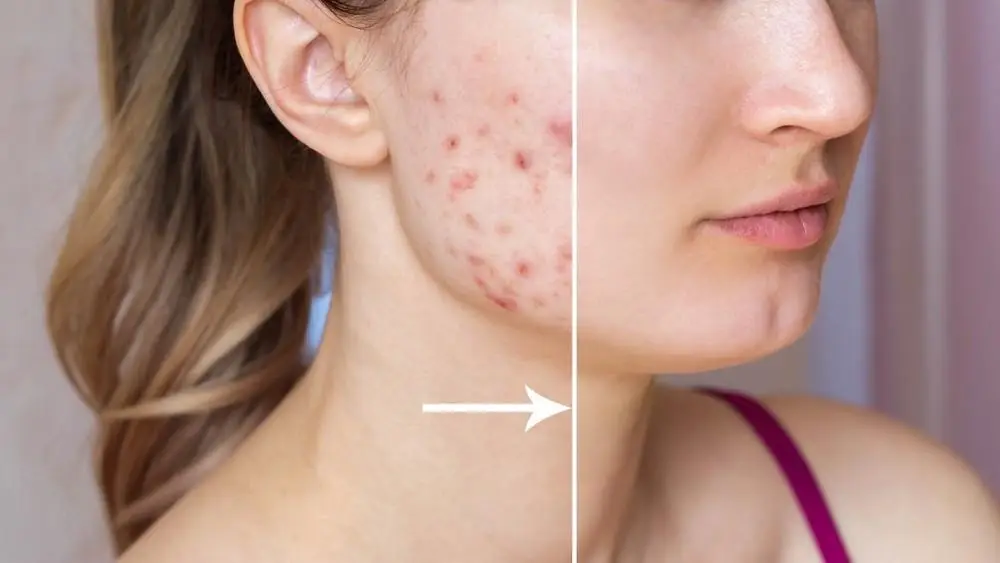
The short version: acne that starts or persists after about 25 is usually hormonally driven rather than a hygiene or diet problem, and it behaves differently from teenage acne. It tends to sit along the jawline and chin, it is often inflammatory rather than blackheads, and it frequently coexists with dry or sensitive skin — which is why products aimed at oily teenage skin can make it worse. Treating it well means identifying the driver, auditing what you are already applying, and separating marks from true scars, because those two need opposite treatments.
What follows is how adult acne differs mechanically from the teenage version, the trap most anti-aging routines create, and how to tell which kind of aftermath you are actually looking at in the mirror.
Why adult acne is not just teenage acne arriving late
All acne involves the same four steps: follicles produce excess sebum, dead skin cells fail to shed cleanly, the follicle blocks, and Cutibacterium acnes proliferates in the blocked follicle and triggers inflammation. That much is shared.
What differs in adults is the driver and therefore the presentation. Androgens stimulate sebaceous glands. In adult women, the relevant change is usually not a rise in total androgen but a shift in the balance between androgens and estrogen — which is why adult acne commonly surfaces in the week before menstruation, after stopping hormonal contraception, during perimenopause, and under sustained stress, when cortisol production competes for the same precursor hormones.
| Teenage pattern | Adult pattern | |
|---|---|---|
| Distribution | Forehead, nose, central cheeks | Jawline, chin, upper neck, sometimes back |
| Lesion type | Blackheads and whiteheads with inflammatory spots | Predominantly inflammatory papules and tender nodules |
| Skin condition | Generally oily throughout | Often combination, dry or sensitive alongside breakouts |
| Timing | Fairly constant | Often cyclical, flaring premenstrually |
| Responds to | Surface oil control, exfoliation | Addressing the hormonal driver plus barrier repair |
The practical consequence: a routine built around strong foaming cleansers, astringents and frequent scrubs treats an oiliness problem that most adults with acne do not have. It strips the barrier, the skin compensates, and the breakouts continue on top of newly irritated skin.
The anti-aging routine paradox
This is the pattern we see most often and the one patients rarely connect themselves. Somewhere in the late twenties or thirties, people start using products aimed at aging: richer night creams, facial oils, heavier sunscreens, overnight occlusive masks. These are reasonable products. But occlusion is exactly what a follicle prone to blocking does not need.
Two things worth separating:
- Genuinely pore-blocking ingredients. Heavy plant oils such as coconut oil, some waxes, certain silicone-heavy formulations and thick occlusive balms. If breakouts began within a month or two of adding a product, that product is a reasonable suspect.
- Retinoid purging, which is not the same thing. Retinoids accelerate cell turnover, which brings existing subclinical blockages to the surface sooner. The result looks like a flare in weeks two to six and then settles. Stopping at week three is the most common reason a retinoid never gets a fair trial. Retinoids are one of the few topicals with consistent evidence in both acne and photoaging — which is useful when both are the concern.
Before adding any treatment, we go through what you are currently applying, in what order, and when each product was introduced. It is unglamorous and it frequently explains the problem.
Marks versus scars: the distinction that decides treatment
Most people arrive asking about acne scars. Most of what they are pointing at is not scarring. Getting this right matters because the two respond to different things, and treating discolouration as though it were a contour scar wastes months.
| What you see | What it is | How it behaves |
|---|---|---|
| Flat red or pink marks | Post-inflammatory erythema — dilated vessels in healed skin | Fades over months; responds to vascular and barrier-directed treatment |
| Flat brown or grey marks | Post-inflammatory hyperpigmentation — excess melanin after inflammation | Fades slowly; responds to pigment-directed treatment and strict sun protection |
| Depressed pits and tethered dents | Atrophic scarring — lost or tethered collagen | Permanent without intervention; needs collagen remodelling |
| Raised firm lumps | Hypertrophic or keloid scarring | Needs a different approach again; not treated with resurfacing |
The simplest test at home: stretch the skin gently, or look at it in raking side light rather than straight-on bathroom light. Discolouration stays flat. A contour scar shows a shadow.
Pigment and redness are also where sun protection stops being generic advice and becomes the treatment itself. Ultraviolet exposure darkens post-inflammatory pigmentation and prolongs it, and in Los Angeles the UV index stays meaningful through the entire year. Unprotected marks simply take longer to clear, whatever else is being done.
What treatment looks like once inflammation is controlled
The sequence matters. Resurfacing skin that still has active inflammatory acne risks worsening both the inflammation and the pigmentation, particularly in deeper skin tones. So active acne is settled first, and the aftermath is treated second.
For the marks and texture left behind, the relevant question is which layer the problem sits in. Surface pigment and dullness respond to treatment that works superficially. Contour scarring sits in the dermis and needs collagen remodelling, which is what radiofrequency microneedling is designed to do — controlled dermal injury plus heat to drive a remodelling response over a course of sessions. Pigment-dominant aftermath may be better served by laser treatment matched to your skin tone, which is a genuine safety consideration and not a formality.
Our general approach to assessment, skin-tone-appropriate treatment selection and physician oversight is set out on the medical skin care page.
One honest limitation: aesthetic treatment manages mild to moderate acne and treats its aftermath well. It does not replace systemic medication. If you have deep painful cysts, acne that is scarring as it heals, or acne unresponsive to months of appropriate topical treatment, the right next step is prescription management — and we will say so rather than sell you a course of facials.
What to bring to a consultation
- Every product you currently apply to your face, including sunscreen, makeup primers and hair products that contact the hairline
- Roughly when each one was introduced
- Any prescription acne treatment you have tried, and for how long
- Whether breakouts track your cycle
- Any change in hormonal contraception in the last year
That history usually narrows the cause faster than looking at the skin alone.
Common questions
Why did I get acne in my 30s when I had clear skin as a teenager?
Adult-onset acne is usually driven by hormones rather than by oil and bacteria alone. Shifts in the ratio of androgens to estrogen, which happen around the menstrual cycle, after stopping hormonal contraception, and through perimenopause, increase sebum production and change how readily pores block. This is why adult acne often appears for the first time in the late twenties or thirties with no change in diet or hygiene.
Why is my acne only along my jawline and chin?
Lower-face distribution across the jawline, chin and upper neck is the pattern most associated with hormonally driven acne. Teenage acne tends to concentrate in the T-zone of the forehead and nose. The distribution matters because it points to the underlying driver, and treatments aimed at surface oil often underperform on jawline acne.
Can anti-aging products cause acne?
They can contribute to it. Rich occlusive moisturisers, heavy facial oils and some cosmetic silicones and waxes can block follicles in skin that is already prone to blocking. Retinoids also cause a purge phase in the first four to six weeks that looks like worsening acne but is part of the expected course. Reviewing a product routine is a standard first step before adding treatment.
Are acne marks the same as acne scars?
No, and the distinction changes the treatment entirely. Flat red or brown marks are post-inflammatory erythema or hyperpigmentation. They are discolouration in intact skin and they fade, though slowly, and respond to pigment-directed treatment. A true scar is a change in the skin’s contour, either depressed or raised, caused by lost or disorganised collagen. Contour scars do not fade with time and need collagen remodelling.
Should I see a dermatologist or a medical spa for adult acne?
If you have deep painful nodules or cysts, acne that is actively scarring, or acne that has not responded to several months of appropriate topical treatment, you need a physician who can prescribe systemic medication such as oral antibiotics, hormonal therapy or isotretinoin. Aesthetic treatment is appropriate for mild to moderate acne, for maintenance once inflammation is controlled, and for the marks and scarring left behind.
How long does it take to see improvement?
Any acne treatment needs a full skin cycle to judge. Expect six to eight weeks before a meaningful change in active breakouts and roughly three months before a fair assessment. Scar and pigment work is slower again, usually a course of sessions spaced four to six weeks apart. Anything promising clear skin in a week is not describing how skin turnover works.
Reviewed by Daniel Moghadam, M.D., founder and medical director of Modern Aesthetica. Last reviewed October 2026. Acne has several distinct causes and some require prescription management. This article is educational and is not a substitute for an in-person assessment.
Modern Aesthetica
8907 Wilshire Blvd, Suite 270, Beverly Hills, CA 90211
Phone: (213) 895-4730
Hours: Mon–Thu 10:00am–5:00pm · Fri 9:00am–5:00pm · Sat & Sun closed
Serving Beverly Hills, West Hollywood, Santa Monica, Brentwood, Hollywood and greater Los Angeles.


