
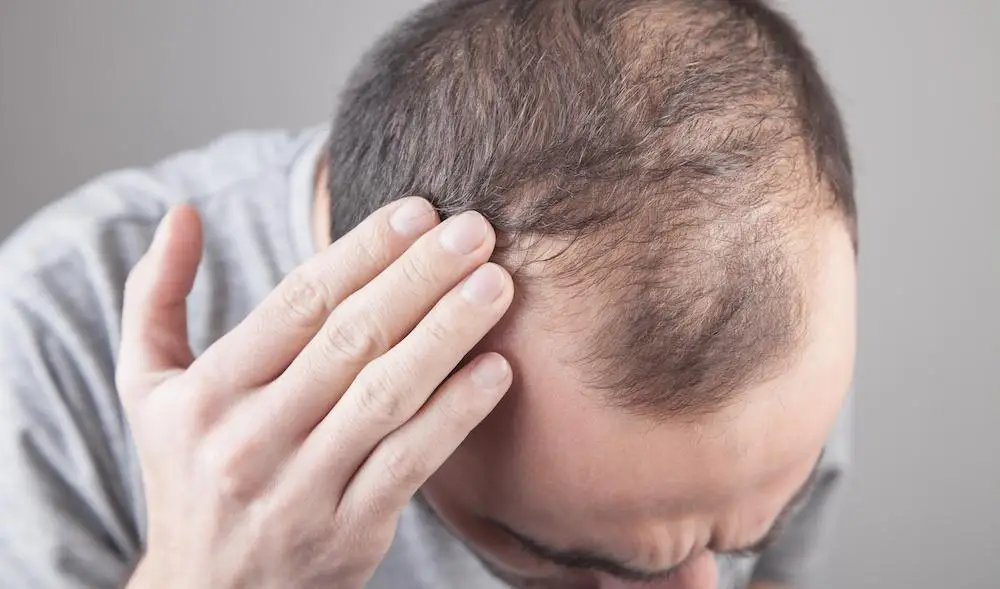
The short version: platelet-rich plasma can meaningfully improve hair density in pattern hair loss, but only where follicles are still alive and shrinking. It cannot regrow hair from scalp that has been smooth and bald for years, because there is nothing left to stimulate. It is also not a replacement for minoxidil or finasteride, which have far more evidence behind them. It works best as an addition to those, started early, in someone whose hair loss has first been properly investigated.
Below is how it works, who responds, what blood work should happen first, and an honest comparison with the established options.
How PRP is supposed to work on hair
In pattern hair loss, follicles do not die suddenly. They miniaturise. Each growth cycle produces a slightly finer, shorter, less pigmented hair, until what remains is barely visible downy hair and eventually nothing. The process is driven by the follicle’s sensitivity to dihydrotestosterone and it happens over years.
PRP is a concentrate of your own platelets, prepared by spinning a blood sample. Platelets carry growth factors involved in tissue signalling and repair. Injected into the scalp, the intent is to improve the local signalling environment around follicles that are still cycling — prolonging the growth phase and thickening the hair each follicle produces.
The crucial implication is in that sentence: still cycling. PRP acts on living follicles. It does not create new ones.
This is the single most useful predictor of whether PRP will help you. Look closely at the thinning area in good light. If you can see fine, short, pale hairs, those are miniaturising follicles and there is something to work with. If the scalp is smooth and shiny with nothing at all, that area will not respond.
What the evidence supports
For androgenetic alopecia, controlled trials and pooled analyses generally report increased hair density and shaft thickness compared with placebo injection. That is a genuine positive signal, and it is more than can be said for many treatments sold for hair.
The honest qualifications matter too. Study sizes are mostly small. Preparation protocols differ substantially between studies — spin speed, platelet concentration, whether white cells are included, injection depth and interval all vary, which makes results hard to compare. And effect sizes are moderate rather than dramatic.
For other diagnoses the picture is weaker. Alopecia areata has some supportive data but less. Scarring alopecias will not respond at all, because the follicle has been replaced by fibrous tissue.
What should happen before any injection
Hair loss is a symptom, not a diagnosis, and several of its causes are treatable without any procedure. Injecting a scalp without establishing why the hair is falling is how people spend money on the wrong problem.
| Worth excluding first | Why it matters |
|---|---|
| Iron deficiency, with ferritin not just haemoglobin | A common and correctable cause of diffuse shedding, particularly in women |
| Thyroid dysfunction | Both under- and overactive thyroid cause hair loss and are treated medically |
| Recent illness, surgery, major stress or childbirth | Telogen effluvium resolves on its own over months; injections are unnecessary |
| Medications | Several common drug classes cause shedding; a change may resolve it |
| Vitamin D and B12 status | Deficiency contributes and is cheap to correct |
| Scalp inflammation or scarring | Points to a different diagnosis entirely, needing different treatment |
If a provider offers to start injections without asking any of this, that is a reasonable moment to pause.
How it compares with the established options
| Evidence base | Role | |
|---|---|---|
| Topical minoxidil | Large; long-established | First-line, for men and women |
| Oral finasteride | Large; long-established in men | First-line in men; used off-label in some women |
| PRP | Moderate; smaller trials, variable protocols | An addition, not a substitute |
| Low-level laser devices | Mixed | Adjunct; modest at best |
| Hair transplant | Well established surgically | For established loss where density is gone |
The practical framing we use: medication slows the process, PRP may improve what the remaining follicles produce, and transplantation moves follicles to where they are gone. They address different parts of the same problem, which is why they are often used together rather than chosen between.
What treatment actually involves
Blood is drawn, spun to separate the platelet-rich fraction, and that fraction is injected across the thinning area in a grid of small injections. The appointment takes under an hour. Topical anaesthetic and cooling make it tolerable; most people call it uncomfortable rather than painful.
A starting course is usually three to four sessions four to six weeks apart, then maintenance every four to six months. Because hair cycles slowly, nothing meaningful shows before three months, and six months is the fair assessment point. Standardised photographs at the same angle and lighting are far more reliable than your impression in the mirror, which is strongly influenced by how recently you washed your hair.
Expect scalp tenderness and mild swelling for a day or two. Avoid harsh shampoos and styling products for 24 hours.
How we prepare and inject PRP, and where we think the evidence is stronger and weaker across indications, is set out on the PRP therapy page.
One limitation worth stating plainly: if you stop, the benefit fades. PRP does not alter the underlying sensitivity of the follicle to DHT. It improves the environment for as long as it is maintained, which makes it an ongoing commitment rather than a one-off fix.
Common questions
Does PRP actually work for hair loss?
For androgenetic alopecia — male and female pattern hair loss — the evidence is reasonably supportive. Multiple controlled trials and pooled analyses report increased hair density and thickness compared with placebo injections. The effect is real but moderate, it is not a cure, and it requires ongoing maintenance. For other causes of hair loss the evidence is much thinner.
Can PRP regrow hair where I am completely bald?
No. PRP works by improving the environment around follicles that are still alive but miniaturising. A follicle that has been dormant for years and scarred over has nothing left to stimulate. This is why results depend heavily on how early treatment starts, and why a scalp that is shiny and smooth rather than covered in fine downy hair is a poor candidate.
How many sessions does PRP for hair take?
A typical starting course is three to four sessions spaced four to six weeks apart, followed by maintenance every four to six months. Hair cycles slowly, so nothing meaningful is visible before about three months and the fuller picture takes six. Judging the result at six weeks will tell you nothing.
Is PRP better than minoxidil or finasteride?
It is not a replacement for them. Minoxidil and finasteride have far larger evidence bases and are the established first-line treatments for pattern hair loss. PRP is best thought of as something added alongside them, particularly for people who cannot tolerate medication or want to improve on a partial response. A provider who positions PRP as a substitute for proven medication is not giving you the full picture.
What causes of hair loss is PRP not appropriate for?
Scarring alopecias, where the follicle is destroyed and replaced with fibrous tissue, will not respond. Hair loss from thyroid disease, iron deficiency, significant nutritional deficiency, recent illness or childbirth, or a medication side effect needs the underlying cause addressed rather than injections. This is why blood work before starting matters.
Does PRP for hair hurt?
The scalp is sensitive and the injections are numerous, so topical anaesthetic and often a cooling device are used. Most people describe it as uncomfortable rather than painful. Expect tenderness and mild swelling for a day or two afterward, and avoid harsh washing or styling products for the first 24 hours.
Reviewed by Daniel Moghadam, M.D., founder and medical director of Modern Aesthetica. Last reviewed October 2026. Hair loss has many causes and several are treatable medically. Blood work and a proper diagnosis should precede any procedural treatment.
Modern Aesthetica
8907 Wilshire Blvd Suite 270, Beverly Hills, CA 90211
Phone: (213) 895-4730
Hours: Mon–Thu 10:00am–5:00pm · Fri 9:00am–5:00pm · Sat & Sun closed
Serving Beverly Hills, West Hollywood, Santa Monica, Brentwood, Hollywood and greater Los Angeles.


