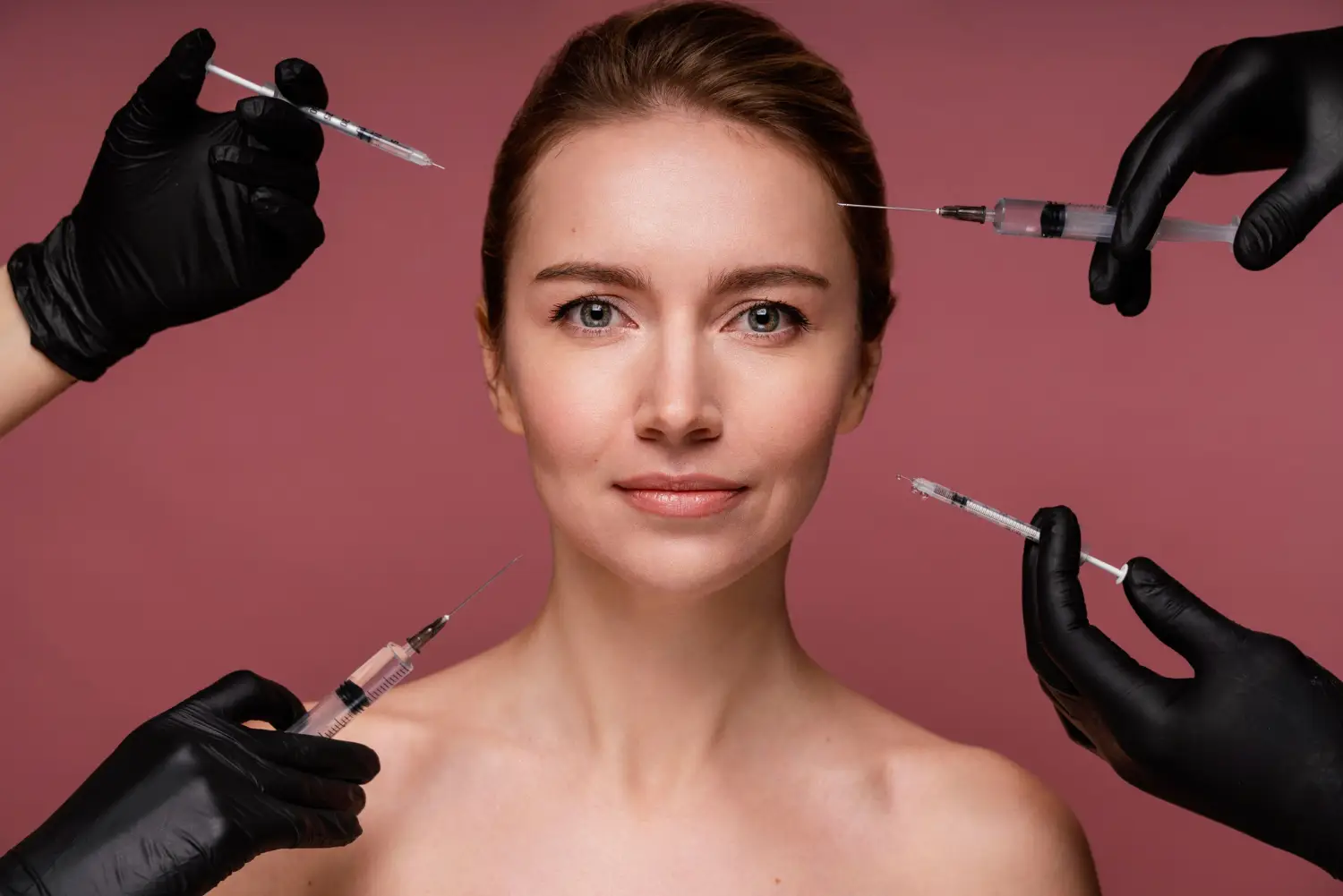
The short version: for horizontal forehead lines that appear when you raise your eyebrows, a neuromodulator such as Botox Cosmetic is the standard treatment and the only one of the two with FDA approval for the forehead. Dermal fillers solve a different problem, volume loss, and the FDA specifically recommends against using them in the forehead because of the risk of blocking a blood vessel. The cases where filler enters the discussion are narrower than most comparison articles imply.
Why the two treatments are not really competitors
Forehead lines come from at least two distinct mechanisms, and each treatment answers only one of them. Dynamic lines are produced by the frontalis, a thin sheet of muscle that lifts the brows, and they deepen every time it contracts. A neuromodulator blocks the release of acetylcholine at the junction between nerve and muscle, so the frontalis contracts less and the skin above it folds less. The lines soften because the cause is quieted, not because anything has been added.
Static lines are creases that remain when the muscle is at rest. They reflect decades of repeated folding combined with collagen loss and sun damage, and a neuromodulator can only reduce the folding that deepens them. Hyaluronic acid filler adds volume beneath a crease, which in principle could lift it, but the forehead is among the least forgiving places in the face to do that, for reasons that have to do with the blood supply of the forehead and glabella. The practical consequence is that most people searching “Botox vs filler for forehead wrinkles” are really asking whether to treat the muscle or the skin, and the answer depends on which kind of line they have.
What the FDA says about each
Botox Cosmetic has been approved for glabellar lines (the frown lines between the brows) since 2002, for lateral canthal lines (crow’s feet) since 2013, and for moderate to severe forehead lines since October 2017, which means the forehead use has been studied in controlled trials and is a labeled indication.
The situation for fillers is the reverse. On its page about dermal fillers, the FDA lists the glabella, nose, periorbital area, forehead and neck among the sites where it recommends against using them, and it describes the most concerning risk as unintentional injection into a blood vessel, which can cause tissue death, vision abnormalities including blindness, and stroke. The forehead and glabella are supplied by branches of the ophthalmic artery that communicate with the retinal circulation, which is the anatomical reason a small amount of material entering the wrong vessel can reach the eye.
What urgent symptoms look like
The FDA tells patients to seek immediate medical attention after a filler injection for unusual pain, vision changes, a white, gray or blue appearance of the skin near the injection site, or any sign of a stroke, and it tells clinicians to stop injecting at once if any of these appear. Any clinic offering filler anywhere near the forehead should be able to explain how it would recognize and manage a vascular event, including its plan for hyaluronidase.
How the treatments compare
| Question | Neuromodulator (Botox Cosmetic) | Hyaluronic acid filler |
|---|---|---|
| What does it act on? | It acts on the frontalis muscle that creates the lines, reducing the contraction that folds the skin | It adds volume beneath a crease or within a contour, without affecting the muscle that moves the skin |
| What is its FDA status for the forehead? | It is approved for moderate to severe forehead lines in adults, on the basis of controlled trials | The forehead is not an approved site, and the FDA recommends against injecting dermal fillers there |
| How quickly does it work, and for how long? | Softening begins within a few days and peaks at about two weeks, with the effect commonly lasting three to four months | The visible effect is immediate, but durability in the forehead is not well studied, even though hyaluronic acid products last many months in other areas |
| What is the most important risk? | Brow or eyelid heaviness when product spreads or is placed too low, which is usually temporary | Vascular occlusion with tissue loss or blindness, which is rare but severe, along with lumps and contour irregularity |
| What can it not do? | It cannot remove a crease that persists at rest or restore volume that has been lost | It cannot stop the muscle movement that creates the line in the first place |
When filler does come up
Experienced injectors do occasionally use small amounts of filler on the forehead, usually for a flat or hollowed contour in a thin face or for a fine etched line that persists after a neuromodulator has quieted the muscle. They do so knowing that it is off-label, that the risk profile is different from the cheeks or lips, and that the technique matters, with slow injection, small volumes, blunt cannulas in some situations and an exact knowledge of the vessels. A patient who is offered forehead filler as a first-line fix for ordinary expression lines, rather than as a considered choice after other options, is entitled to ask why it was preferred over a neuromodulator.
Filler in other parts of the face addresses a different set of concerns, and the same reasoning about comparing like with like applies; our article on filler done badly, including migration and overfilling and how to recognize them describes what goes wrong when the technique or the product choice is poor.
The main risk of Botox in the forehead, and how it is managed
The characteristic problem with treating the forehead with a neuromodulator is not the injection but the balance. The frontalis is the only muscle that lifts the brows, and when it is relaxed too much, or when product is placed low, the brows can drop and the upper lids can feel heavy. A consensus review of botulinum toxin-induced ptosis notes that the pivotal US multicenter trial recorded ptosis in 5.4 percent of patients, that many of those cases were attributed to inexperienced injectors, and that the rate for experienced injectors is far lower and more likely under one percent; it also notes that the figure is for ptosis generally, not for the forehead alone. The same review describes brow ptosis as self-limiting, usually settling within about six weeks, although it can persist for the full duration of the toxin’s effect.
Several habits reduce the risk. The consensus review advises injecting at mid-forehead or above, at least two centimeters above the brow in every patient and at least four centimeters above it in older patients, and never treating the frontalis in isolation, particularly after age fifty, so that the frown muscles that pull the brows down are treated at the same time as the muscle that lifts them. It also advises conservative amounts with a reassessment at about two weeks rather than a heavy first dose, caution after previous forehead surgery, and a simple pre-treatment check: if the brows descend when the patient sits upright, looks straight ahead and closes the eyes, the forehead lines should not be treated. People with naturally low or heavy brows or already drooping upper eyelid skin often fall in that group, and for them the most useful answer may be a smaller dose or a different approach. For the aftercare that protects the result, see what not to do after Botox and why those rules exist.
What to do about lines that remain
If creases persist at rest after the muscle has been treated, they are static lines, and they respond to approaches that act on the skin: prescription retinoids over months, resurfacing and collagen-stimulating treatments such as microneedling or radiofrequency microneedling, and consistent sunscreen. Our companion article on what actually softens horizontal forehead lines walks through the options by type of line, and the piece on forehead Botox for prevention covers whether starting early changes anything.
Dr. Daniel Moghadam offers Botox and dermal fillers at Modern Aesthetica in Beverly Hills. Pricing for a neuromodulator depends on the number of units needed, which varies with muscle strength and brow position, so the useful question at a consultation is how many units are planned for which areas, and what the follow-up policy is if the result needs adjustment.
Common questions
Is Botox or filler better for forehead wrinkles?
For the horizontal lines that appear when you raise your eyebrows, a neuromodulator such as Botox Cosmetic is the standard treatment and carries FDA approval for the forehead, whereas dermal fillers are not an approved use there and the FDA recommends against injecting them in that region because of the risk of blocking a blood vessel.
Can dermal fillers be used on the forehead at all?
Some experienced injectors place small volumes for contour or for etched lines that persist after the muscle has been treated, doing so knowingly off-label, but the risk is higher than in other facial areas and the choice should come after conventional options rather than before them.
How long does Botox last on the forehead?
Most patients see the effect for about three to four months, with onset within a few days and the full result at around two weeks, although duration varies with dose, muscle strength and individual metabolism, and the frontalis gradually recovers its movement as the effect fades.
Will Botox make my eyebrows drop?
Brow heaviness affects a minority of patients and becomes more likely when product is placed too low, when the dose is excessive or when the injector lacks experience, but it usually settles within about six weeks, and treating the muscles that pull the brows down in the same session reduces the likelihood.
What are the signs of a filler complication?
Unusual pain, vision changes, a white, gray or blue appearance of the skin near the injection site, or any sign of a stroke all require immediate medical attention, as the FDA advises, because delays in treating a blocked vessel can determine whether tissue or vision is preserved.
Why do my forehead lines remain after Botox?
The remaining creases are probably static lines, which persist when the muscle is at rest because of accumulated collagen loss and sun damage, and while a neuromodulator prevents them from deepening it does not erase them; skin-directed treatments such as retinoids, microneedling and resurfacing address them more effectively.
How much does forehead Botox cost?
The cost depends on the number of units required, which differs considerably between people according to muscle strength and brow position, so the most useful approach is to ask at the consultation for the planned units by area and the total in writing, together with the clinic’s policy on adjustments.
Sources
- FDA: dermal fillers (soft tissue fillers), including the list of unapproved uses and the warning about injection into a blood vessel
- Botox Cosmetic approval history, including forehead lines (October 3, 2017)
- King M et al. Management of ptosis. Journal of Clinical and Aesthetic Dermatology 2016;9(12):E1-E4
Reviewed by Daniel Moghadam, M.D., founder and medical director of Modern Aesthetica. Last reviewed November 2026. This article is educational and is not a substitute for a consultation; what is appropriate for you depends on your history, your examination and your goals.
Modern Aesthetica
8907 Wilshire Blvd, Suite 270, Beverly Hills, CA 90211
Phone: (213) 895-4730
Hours: Mon–Thu 10:00am–5:00pm · Fri 9:00am–5:00pm · Sat & Sun closed
Serving Beverly Hills, West Hollywood, Santa Monica, Brentwood, Hollywood and greater Los Angeles.