
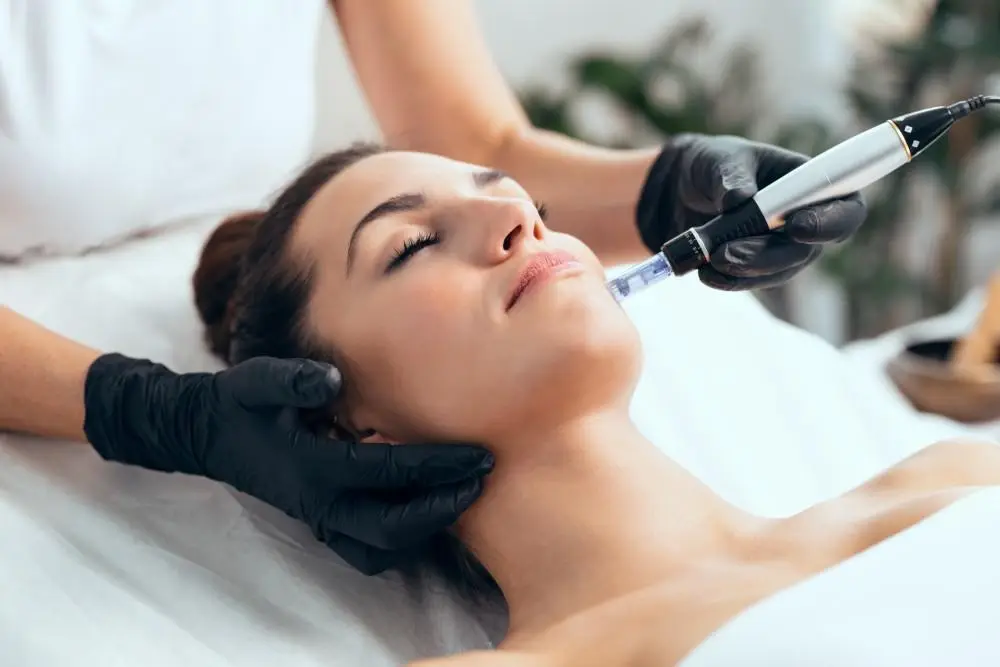
The short version: epidermal growth factor is a real signalling molecule with a real role in wound healing. The practical problem is size — it is a protein far too large to cross intact skin in meaningful quantity, which is why it is paired with microneedling rather than sold as a cream that works alone. In an EGF microneedling facial, the needling is doing most of the work. The growth factors are a plausible supporting addition with limited evidence that they improve the outcome, and the sourcing varies more than most product pages admit.
Below is what EGF is, where it comes from, the penetration question, and how to think about the safety concern people raise.
What EGF actually is
Epidermal growth factor is a protein your body produces. Its job is signalling: when tissue is injured, growth factors instruct nearby cells to divide, migrate into the wound and rebuild. It is part of the normal healing cascade, and its discovery was significant enough to earn a Nobel Prize.
The reasoning behind using it in skincare is that ageing skin produces fewer growth factors and heals more slowly, so supplying them may support renewal. That reasoning is sound in principle. The difficulty is delivery.
The size problem
The outer layer of skin is a barrier designed to keep things out. The commonly cited practical ceiling for a molecule passively crossing it is around 500 daltons. EGF is a protein of roughly 6,000 daltons — an order of magnitude larger.
Applied to intact skin, most of it stays on the surface. That is not marketing cynicism, it is the barrier doing exactly what it exists to do.
Which is why pairing growth factors with microneedling is not an upsell so much as the only way the ingredient has a plausible route in. The needling creates temporary channels through the barrier, and the growth factors are applied while those channels are open. If you are using an EGF serum at home on intact skin, the realistic expectation is the hydration and texture benefit of the base formulation rather than a growth factor effect.
Where the EGF in your product comes from
This varies considerably and is rarely explained clearly.
| Source | What it is | Worth knowing |
|---|---|---|
| Recombinant human EGF | The human gene inserted into bacteria, yeast or barley, which produce the protein | The same molecule as human EGF; the most common form in serious formulations |
| Human cell culture derived | Growth factor mixtures harvested from cultured human cells | A mixture rather than a single molecule; composition varies by manufacturer |
| Snail secretion filtrate | Mucin containing various glycoproteins and growth factors | Genuine moisturising and soothing properties; not standardised EGF |
| Plant-derived “growth factors” | Plant molecules marketed as analogous | Not the human molecule; plants do not produce human EGF |
Two further issues apply regardless of source. Proteins are fragile — they degrade with heat, light and time, so formulation and packaging materially affect whether anything active remains by the time you use it. And concentration is almost never disclosed, which makes products impossible to compare on anything but price.
The safety question people actually ask
The concern is reasonable and worth answering directly rather than dismissing: if growth factors tell cells to divide, could they encourage something you do not want to grow?
No causal link has been demonstrated in humans from topical cosmetic use. The amounts are small, penetration is limited, and growth factor signalling is tightly regulated in tissue. At the same time, the theoretical concern is not absurd, and the sensible response is proportionate caution rather than either alarm or dismissal.
In practice that means not applying growth factors over undiagnosed or suspicious lesions, avoiding them during active treatment for skin cancer, and — particularly relevant for anyone with significant sun damage, which in Los Angeles is most people — having your skin properly examined by a dermatologist. Sun-damaged skin is the population most likely to be seeking these treatments and most likely to have lesions worth checking.
What the treatment realistically delivers
An EGF microneedling facial combines controlled micro-injury with growth factors applied into the channels created. Separating the two components honestly:
- The microneedling is doing the structural work. Controlled dermal injury triggers collagen remodelling, which is what improves texture, fine lines and the surface quality of sun-damaged skin over a course of sessions.
- The growth factors are a plausible support. The intent is to assist the healing response. Evidence that this meaningfully improves the outcome over needling alone is limited, and we would rather say so than imply otherwise.
- What is applied matters for safety as much as benefit. An open barrier absorbs irritants as readily as actives. Nothing with fragrance, alcohol, essential oils or low-pH acids belongs on freshly needled skin.
How we perform the treatment is set out on the EGF microneedling facial page. If your concern is structural — laxity or deeper scarring rather than surface quality — radiofrequency microneedling reaches further and is the better choice. And for sun damage specifically, the measure with the strongest evidence remains daily sun protection, which is covered on the medical skin care page.
A fair way to decide: if the price difference between standard microneedling and an EGF version is modest, the addition is reasonable. If it is substantial, you are paying a premium for the component with the least evidence behind it.
Common questions
What is EGF in skincare?
Epidermal growth factor is a small protein your body produces naturally that signals skin cells to divide and migrate during wound healing. In skincare it is used as an active ingredient on the reasoning that supplying it topically may support repair and renewal. It is a signalling molecule rather than a structural ingredient, which makes it different from something like hyaluronic acid.
Where does the EGF in skincare actually come from?
Most commonly it is recombinant human EGF, produced by inserting the human gene into bacteria, yeast or barley, which then manufacture the protein. Some products use growth factors derived from human cell cultures, and others use snail secretion filtrate or plant-derived molecules marketed as equivalents. Plant-derived versions are not the same molecule as human EGF, which is worth knowing when comparing products.
Can growth factors penetrate the skin?
This is the central technical objection and it is a fair one. EGF is a protein of roughly 6 kilodaltons, well above the size generally cited as the practical ceiling for passive absorption through intact skin. Applied to undamaged skin, much of it likely remains on the surface. This is precisely why it is usually paired with microneedling, which creates temporary channels through the barrier.
Is it safe to put growth factors on your skin?
For most people, yes, and no causal link to cancer has been demonstrated in humans from topical use. The theoretical concern is that growth factors promote cell division, so applying them to skin with an undiagnosed malignancy is undesirable in principle. The sensible precautions are to avoid them over suspicious or undiagnosed lesions, to avoid them during active skin cancer treatment, and to have your skin examined if you have significant sun damage.
Is an EGF microneedling facial better than microneedling alone?
The microneedling itself is doing most of the structural work by triggering collagen remodelling. Adding growth factors is intended to support the healing response that follows. The evidence that it meaningfully improves the outcome over microneedling alone is limited. It is a reasonable addition rather than the main event, and it should be priced and described that way.
What should not be applied after microneedling?
Anything with fragrance, alcohol, essential oils, acids or vitamin C in a low-pH formulation. Freshly needled skin absorbs irritants as readily as it absorbs actives, and the barrier is temporarily open. This is a genuine safety point rather than an upsell, and it is why what gets applied during the treatment should be chosen deliberately.
Reviewed by Daniel Moghadam, M.D., founder and medical director of Modern Aesthetica. Last reviewed October 2026. Significant sun damage should be assessed by a dermatologist. Growth factor products are not appropriate over undiagnosed lesions.
Modern Aesthetica
8907 Wilshire Blvd Suite 270, Beverly Hills, CA 90211
Phone: (213) 895-4730
Hours: Mon–Thu 10:00am–5:00pm · Fri 9:00am–5:00pm · Sat & Sun closed
Serving Beverly Hills, West Hollywood, Santa Monica, Brentwood, Hollywood and greater Los Angeles.


