
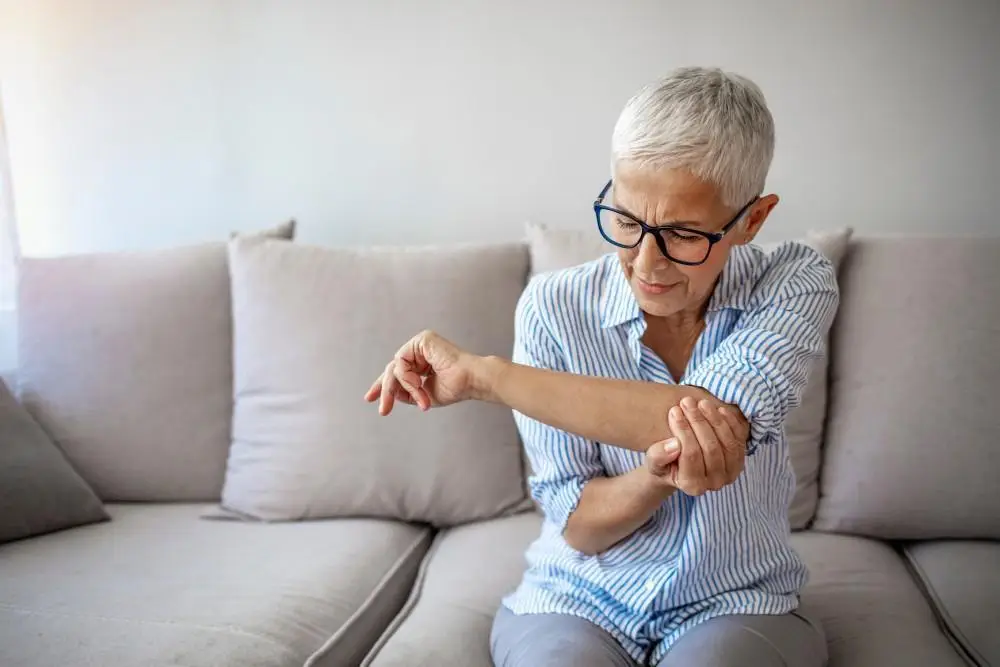
The short version: tennis elbow is not an inflammatory condition, despite the name. Tissue from long-standing cases shows degeneration and a failed healing response rather than inflammation. That single fact reorders the treatment: anti-inflammatory approaches target a process that is largely absent, which is why they relieve pain short term and disappoint later. Progressive loading of the tendon has the most consistent evidence, and it is slow enough that most people abandon it before it works.
Below is what is actually happening in the tendon, why the usual treatments underperform, and where injections reasonably fit.
What is actually wrong with the tendon
Tennis elbow — lateral epicondylalgia — causes pain at the outer elbow where the wrist extensor tendons attach, typically worse with gripping, lifting with the palm down, or shaking hands.
When that tissue is examined, the findings are not what the name suggests. Instead of inflammatory cells there is collagen that has lost its normal parallel organisation, abnormal ingrowth of small blood vessels and nerves, and an increase in ground substance. The picture is of a repair process that started and failed to complete.
The abnormal nerve ingrowth is relevant to why it hurts so much relative to how little is structurally torn, and it explains why pain and tissue damage correlate poorly here.
The naming matters clinically rather than academically. The suffix in tendinitis points treatment toward suppressing inflammation. If the dominant problem is failed remodelling, suppressing inflammation addresses the wrong target — and may interfere with the repair process you actually want.
Why rest and anti-inflammatories disappoint
Complete rest. Tendon requires load to remodel. Prolonged unloading allows further disorganisation and deconditioning, so pain often returns as soon as normal activity resumes. Relative modification of aggravating activity is useful; complete rest generally is not.
Anti-inflammatory medication. Reduces pain in the short term. It does not restore tendon structure, and the relief can encourage a return to full activity before the tendon can tolerate it.
Corticosteroid injection. This is where the evidence is most pointed. Steroid injection gives marked short-term relief — genuinely effective at six weeks. But trials following patients to one year have found worse outcomes and higher recurrence in the steroid group than in those treated with exercise, and in some comparisons worse than conservative management alone. Powerful early relief, poorer long-term result.
| Treatment | Short term | Longer term |
|---|---|---|
| Complete rest | Pain settles | Recurrence on return to activity; deconditioning |
| Anti-inflammatory medication | Modest relief | No structural change |
| Corticosteroid injection | Marked relief | Worse outcomes and higher recurrence at one year |
| Progressive loading | Often some discomfort during exercises | The most consistent evidence for lasting improvement |
| Platelet-rich plasma | Slower onset; soreness early | More encouraging than for arthritis; evidence mixed |
What the evidence supports
Progressive, controlled loading of the tendon. The principle is that graded mechanical load stimulates the remodelling the failed healing response did not finish, gradually restoring organised collagen and the tendon’s capacity to tolerate work.
Three things make it hard to stick with, and all three are worth knowing in advance:
- It is slow. Months, not weeks. Three to six months of consistent work is normal, with return to full activity after that.
- Some discomfort during exercise is expected and acceptable. This feels wrong, which is why people stop. Guidance on what level of discomfort is acceptable is part of a properly supervised programme.
- It must progress. Doing the same exercise at the same load for months does not drive remodelling.
Alongside it: modifying the specific aggravating activity rather than resting entirely, and looking at the cause — grip size, technique, workstation setup, or the repetitive task that produced it. Treating the tendon without changing what loaded it is a reliable route to recurrence.
Where injections fit
Corticosteroid. Defensible for pain severe enough to prevent sleep or to prevent starting a loading programme at all. The framing matters: it buys a window for rehabilitation rather than being the treatment. It should not be repeated routinely.
Platelet-rich plasma. The rationale fits the biology better here than in osteoarthritis — if the problem is a failed healing response, a treatment aimed at stimulating healing is at least addressing the right target. Several trials comparing PRP with corticosteroid report better outcomes at longer follow-up, though trial quality varies and findings are not uniform.
Our position is that PRP is a reasonable option for tendinopathy that has not responded to a genuine loading programme, rather than a first step. Expect soreness in the first week, and assess at six to twelve weeks rather than days. Where we think the evidence is stronger and weaker across indications is set out on the PRP therapy page, and elbow-specific assessment on the elbow pain page.
An adequate trial of loading means a properly progressed programme followed for three months, not a sheet of exercises done inconsistently for a fortnight. If that has not happened, it has not failed.
When elbow pain is not tendinopathy
- Pain with numbness or tingling into the ring and little fingers, suggesting nerve involvement at the elbow
- Locking, catching or the joint giving way
- Significant swelling, warmth or redness, particularly with fever
- Pain following a fall or direct injury
- Night pain unrelated to position, or rapidly worsening pain
- Neck symptoms alongside, since cervical problems can refer pain to the elbow
These warrant assessment rather than a tendon loading programme. The same principles apply to other tendinopathies — shoulder and hip tendon pain follow the same logic, which we cover on the shoulder and hip pages.
Common questions
Is tennis elbow actually inflammation?
Generally not. When tissue from long-standing tennis elbow is examined, what is found is degeneration — disorganised collagen, abnormal blood vessel and nerve ingrowth, and a failed healing response — rather than the inflammatory cells the name implies. The suffix in tendinitis is misleading, which is why tendinopathy or tendinosis is the more accurate term and why anti-inflammatory strategies often disappoint beyond the short term.
Why do anti-inflammatory treatments not fix tennis elbow?
Because they target a process that is largely not the problem. Anti-inflammatories and corticosteroid injections can reduce pain in the short term, and that relief is genuine. But they do not restore the tendon’s disorganised structure, and there is evidence that corticosteroid injection produces worse outcomes at one year than exercise-based treatment or even than doing nothing beyond simple measures.
What actually treats tennis elbow?
Progressive loading of the tendon is the treatment with the most consistent support. Controlled, gradually increased load appears to stimulate the remodelling that the failed healing response did not complete. It is slow, requiring months rather than weeks, and it frequently involves some discomfort during the exercises, which is why people abandon it. Activity modification and addressing technique or workstation factors sit alongside it.
Is a corticosteroid injection ever appropriate?
It can be reasonable for severe pain that is preventing sleep or preventing someone from starting a loading programme at all. The important thing is to treat it as a short-term measure that creates a window for rehabilitation, not as the treatment itself, and not to repeat it routinely. Repeated injections into a degenerative tendon are associated with poorer long-term results.
Does PRP work for tennis elbow?
The evidence here is more encouraging than for osteoarthritis, though still mixed. Several trials comparing platelet-rich plasma with corticosteroid report better outcomes at longer follow-up, which fits the biology, since the problem is a failed healing response rather than inflammation. Trial quality varies and results are not uniform. We would describe it as a reasonable option for tendinopathy that has not responded to a proper loading programme, not as a first step.
How long does recovery take?
Longer than most people expect. Tendon remodelling is measured in months, and a realistic loading programme runs three to six months with gradual return to full activity after that. Expecting resolution in a few weeks is the most common reason an effective programme gets abandoned before it has had a chance to work.
Reviewed by Daniel Moghadam, M.D., founder and medical director of Modern Aesthetica. Last reviewed October 2026. Elbow pain has several causes, some requiring different treatment. Nerve symptoms, locking, significant swelling or injury should be assessed promptly.
Modern Aesthetica
8907 Wilshire Blvd Suite 270, Beverly Hills, CA 90211
Phone: (213) 895-4730
Hours: Mon–Thu 10:00am–5:00pm · Fri 9:00am–5:00pm · Sat & Sun closed
Serving Beverly Hills, West Hollywood, Santa Monica, Brentwood, Hollywood and greater Los Angeles.


